Summary:
If you’ve ever bought blinds at a big-box store, wrestled with a measuring tape, and ended up with something that doesn’t quite fit — you already know why this page exists. Getting blinds right takes more than picking a color. It takes knowing what materials hold up in your specific environment, what installation actually involves, and what questions to ask before you commit to anything.
Brunswick County throws a few extra variables into the mix: salt air, high humidity, intense UV exposure, and a vacation rental market that demands durability above everything else. This guide is built around those realities — so you can make a confident decision and not have to do it again in two years.
Room Darkening Blinds: What They Actually Do and When You Need Them
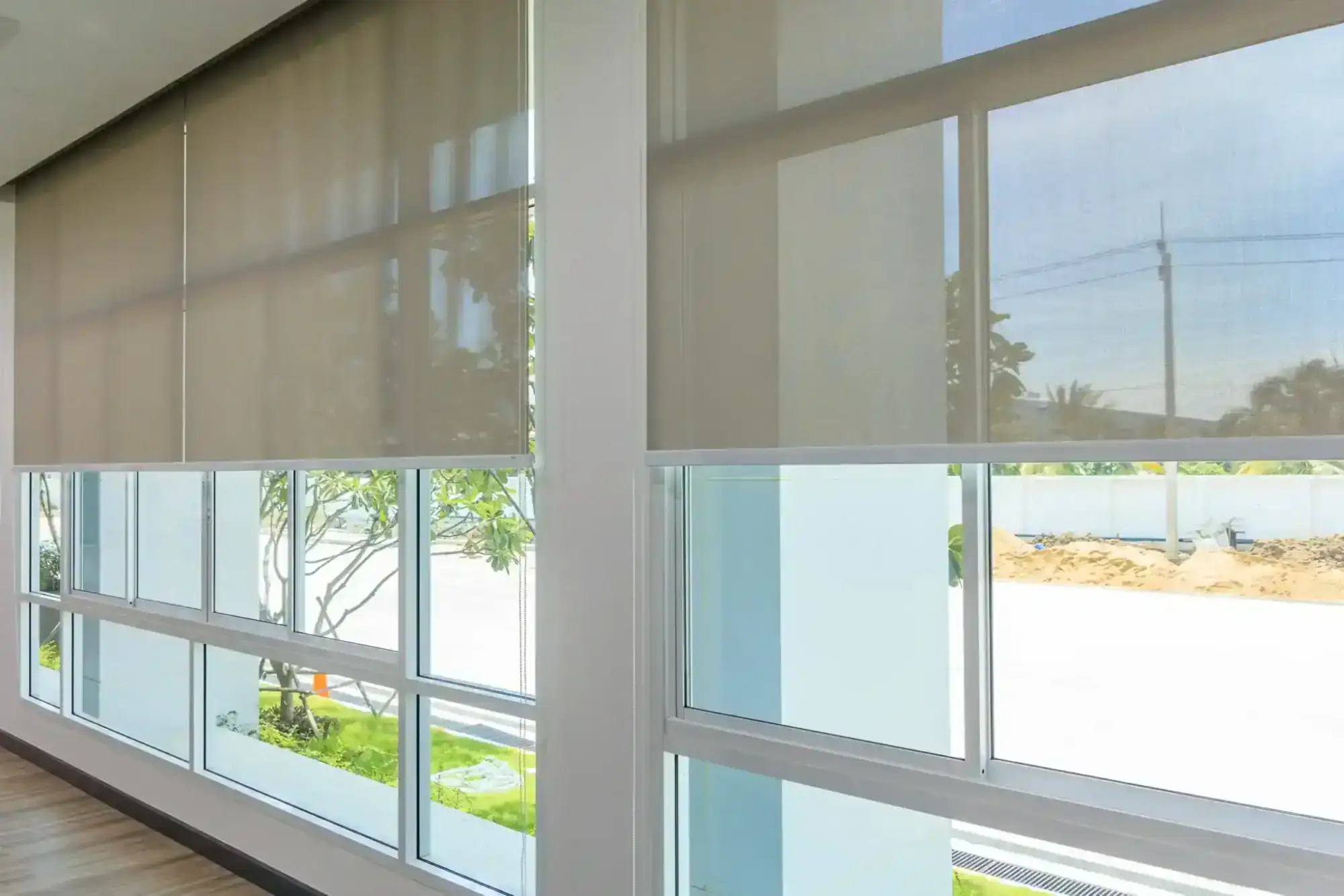
Room darkening blinds reduce the amount of light entering a space significantly — but they don’t eliminate it entirely. There’s usually some light bleed around the edges of the frame, which is normal and expected. If you need near-total darkness, that’s a different product category entirely.
For most bedrooms, living rooms, and home offices, room darkening is exactly the right call. It cuts glare, gives you privacy, and makes a real difference in how well a space functions — especially in a coastal Brunswick County home where the sun angle and reflections off the water can be brutal in the morning.
Blackout Roller Blinds: The Right Choice for Vacation Rental Bedrooms

Blackout roller blinds go a step further than room darkening — they block virtually all light, including the edges, when installed with a proper cassette or side channel system. For vacation rental properties on Oak Island, Ocean Isle Beach, or Holden Beach, this distinction matters a lot. Guests sleeping in a beach house bedroom at 6 a.m. with the sun coming off the water will notice the difference immediately, and so will your rental reviews.
The roller mechanism itself is one of the more durable options available. There are no slats to bend or break, no horizontal pieces for a guest to accidentally lean against. The fabric rolls up cleanly and the operation is simple enough that anyone can figure it out without instructions. For high-turnover properties, that simplicity is a genuine advantage.
From a material standpoint, blackout roller blinds in a coastal environment should use a moisture-resistant fabric backing. Standard blackout fabrics can hold up fine in a climate-controlled home, but a beach rental that gets opened up during humid summers needs something that won’t develop mildew or lose its shape over time. This is the kind of product-specific knowledge that makes a difference when you’re buying for a property rather than just a single room.
Sizing is also critical with roller blinds. Unlike some other styles that have a little forgiveness in the fit, a roller blind that’s even slightly too wide won’t roll cleanly. Professional measurement here isn’t optional — it’s how you avoid an expensive mistake on a product that can’t be easily trimmed or adjusted after the fact.
Cellular Blinds and Honeycomb Blinds: The Energy Efficiency Option for Coastal NC Homes
Cellular blinds — also called honeycomb blinds, because of the cross-section shape of the cells — work differently from most other blind types. Instead of blocking light with a solid material or adjustable slats, they trap air inside a series of pockets between the window glass and your room. That trapped air acts as insulation, slowing the transfer of heat in both directions.
Windows account for 25 to 30 percent of a home’s heating and cooling energy use. Cellular blinds can reduce heat loss through windows by up to 40 percent. In Brunswick County, where summer cooling costs are a real line item for most homeowners, that kind of performance adds up over time.
Double-cell and triple-cell versions provide even better insulation than single-cell designs, though they come at a higher price point. For south-facing or east-facing windows in a coastal home — the ones that take the most direct sun during the hottest parts of the day — the upgrade is usually worth it.
One thing worth knowing: cellular blinds come in a wide range of light-filtering levels. You can get them in sheer, light-filtering, room-darkening, or blackout fabrics, which means the energy saving blinds benefit doesn’t require you to sacrifice natural light. A light-filtering cellular blind on a living room window gives you the insulation performance and still lets the view come through softly. That balance is something a lot of coastal homeowners are specifically looking for — they moved here for the light and the water, and they don’t want to block it out completely.
For homes in Leland’s newer subdivisions or the retirement communities around Brunswick Forest, where energy efficiency and long-term value are front-of-mind, cellular shades are consistently one of the most popular recommendations we make.
Bamboo Blinds and Fabric Options for the Coastal Aesthetic
Bamboo blinds fit naturally into the design language of coastal North Carolina homes — the natural texture, the warm tones, the way light filters through the weave. They photograph well, they feel relaxed without being casual, and they work in almost any room where you want a softer, more organic look.
The tradeoff is durability. In homes more than a mile or two from the water, bamboo holds up fine. But in properties directly on the barrier islands — Sunset Beach, Holden Beach, Ocean Isle — the combination of salt air, humidity, and UV exposure will shorten their lifespan noticeably compared to synthetic alternatives. For Brunswick County properties within sight of the ocean, we typically recommend faux wood or composite materials instead.

Roman Blinds for Windows: Soft, Tailored, and Fully Customizable
Roman blinds are a fabric shade that folds into horizontal pleats when raised and lies flat when lowered. The result is a clean, tailored look that reads more like a soft furnishing than a window covering — which is exactly why they work so well in primary bedrooms, dining rooms, and living spaces where you want the window treatment to feel like part of the interior design, not just a functional addition.
Because they’re made from a single panel of fabric, roman blinds for windows can be ordered in virtually any fabric, pattern, or lining combination. Blackout lining, light-filtering lining, thermal lining — the same clean silhouette, different performance levels depending on what the room needs.
Custom sizing is where roman blinds really shine. A bay window in a Southport home, an arched window in a new construction in Leland, an oversized window in a beachfront property — these are the kinds of installations where stock sizes fail and custom fabrication is the only real option. The fabric is cut and sewn to your exact window dimensions, which means no gaps, no awkward pooling at the bottom, and no visual compromise.
One practical note: roman blinds require more care than hard blinds. The fabric needs to be vacuumed or professionally cleaned periodically, and they’re not the right call for a bathroom or kitchen where moisture is a constant factor. For the right room, though, they’re one of the most elegant window treatment options available.
Cordless Roman Blinds: The Cleaner, Safer Option for Homes with Kids or Guests
Cordless roman blinds operate by lifting the bottom rail directly — no pull cord, no loop, nothing hanging at the side of the window. The Consumer Product Safety Commission has issued strong guidance recommending cordless window coverings in any home where children under six are present, and the reasoning is straightforward: dangling cords are a documented strangulation hazard.
For vacation rental properties in Brunswick County, cordless designs make sense for a different reason. Guests don’t have to figure out a cord system they’ve never seen before, there’s nothing to tangle or break, and the clean look photographs better for your listing. When you’re managing a property on Ocean Isle Beach or Oak Island and you need window coverings that are both guest-proof and attractive, cordless fabric blinds check both boxes.
The operation on a well-made cordless roman blind is smooth and intuitive — you lift from the bottom rail, it stays where you put it. There’s no learning curve. The simplicity is part of what makes them a good fit for guest bedrooms, children’s rooms, and any space where you want the window treatment to be completely unobtrusive.
From a design standpoint, removing the cord also cleans up the visual. There’s nothing interrupting the fabric panel, nothing to tuck away or manage. The blind just looks finished. For rooms where you’ve invested in quality furniture and finishes, that visual cleanliness matters more than it might seem.
Window Blinds Installation: Why Professional Measurement Matters
The difference between buying blinds and getting the right blinds comes down to who’s measuring, what they’re recommending, and whether they understand the environment your home is actually in. A product that works beautifully in a Charlotte suburb can fail within two seasons on a barrier island. That’s not a quality issue with the blind — it’s a fit issue between the product and the place.
We bring samples directly to your home, measure every window ourselves, and handle the installation personally. If you’re ready to figure out what actually works for your home in Brunswick County, NC, reach out and we’ll start there.