Summary:
If you’ve lived near the water in Brunswick County for more than one season, you already know the coast doesn’t play nice with anything that isn’t built for it. Deck furniture rusts. Paint peels. And window treatments — if you bought the wrong ones — warp, corrode, and fall apart faster than you’d believe.
The problem isn’t that you made a bad choice. It’s that most window treatment options aren’t designed for places like Ocean Isle Beach or Sunset Beach. They’re designed for climates that don’t have salt in the air every single day. Here’s what actually works — and why it matters more than most people realize before they move here.
Salt Air Window Treatments: Choosing Materials That Actually Last on the Coast
The single biggest mistake coastal homeowners make is treating window treatment shopping like an inland decision. You walk into a big-box store, pick something that looks good, and assume it’ll hold up. Two years later, the tilt rods are rusting, the slats are warping, and the mounting brackets are corroding at the wall.
Salt air doesn’t just affect what’s outside your home. It gets in. And standard metal hardware — the kind used in most off-the-shelf blinds — simply isn’t built to handle it. The same goes for real wood. In a high-humidity, salt-air environment like Brunswick County, real wood blinds and shutters will crack, swell, and discolor within a season or two. It’s not a matter of if — it’s when.
The materials that hold up are faux wood, PVC, polysatin composites, and vinyl. They won’t warp in humidity. They won’t crack under coastal UV. And when paired with stainless steel or powder-coated hardware, they won’t corrode from salt air exposure. That combination — the right material with the right hardware — is the baseline for anything going into a coastal home in Brunswick County.
Marine Environment Blinds: What Corrosion-Resistant Hardware Actually Means
When you hear “corrosion-resistant hardware,” it’s easy to assume that’s marketing language for something that’s just slightly better than average. In a marine environment like the Brunswick Islands, it’s the difference between window treatments that last a decade and ones that start failing before your second hurricane season.
Standard metal components — tilt rods, hinges, mounting brackets — are typically made from aluminum or steel that isn’t treated for salt exposure. In a home on Holden Beach or along the Intracoastal Waterway in Shallotte, that hardware can begin showing rust and corrosion within 12 to 18 months. It’s not dramatic at first. You’ll notice the tilt mechanism getting stiff. Then a bracket starts to discolor. Then something breaks entirely.
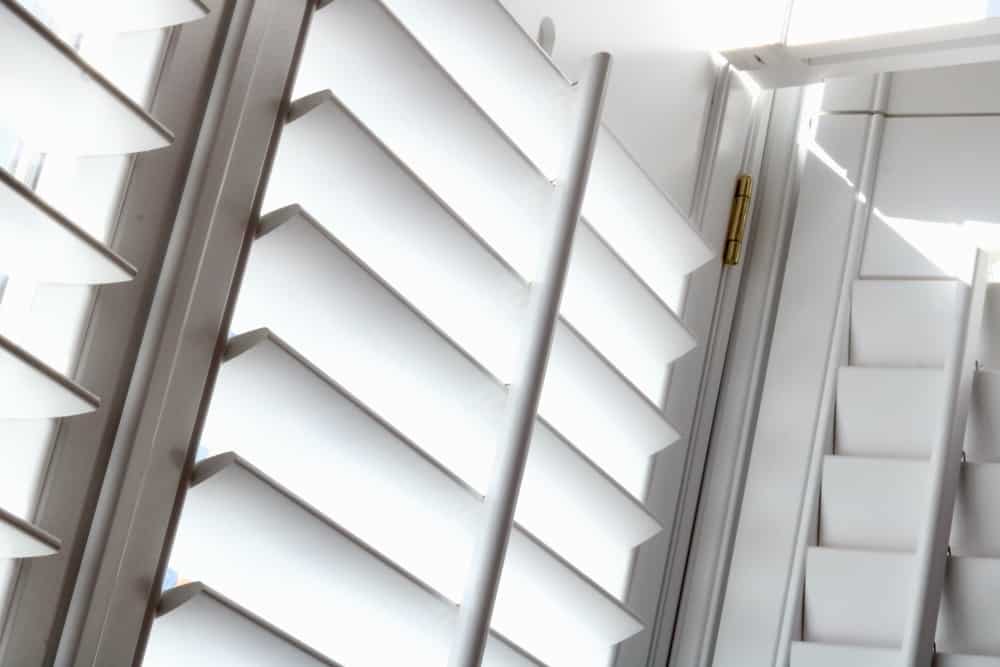
Stainless steel and powder-coated aluminum are the two hardware standards worth insisting on. Stainless steel doesn’t corrode — period. Powder-coated aluminum creates a sealed surface that resists salt air far longer than bare or painted metal. Norman’s Woodlore Plus Shutters, for example, are built with ABS copolymer frames and stainless steel hinges specifically because the manufacturer understands what marine environments do to standard components. That’s not a coincidence — it’s engineering for the actual conditions coastal homeowners in Brunswick County face.
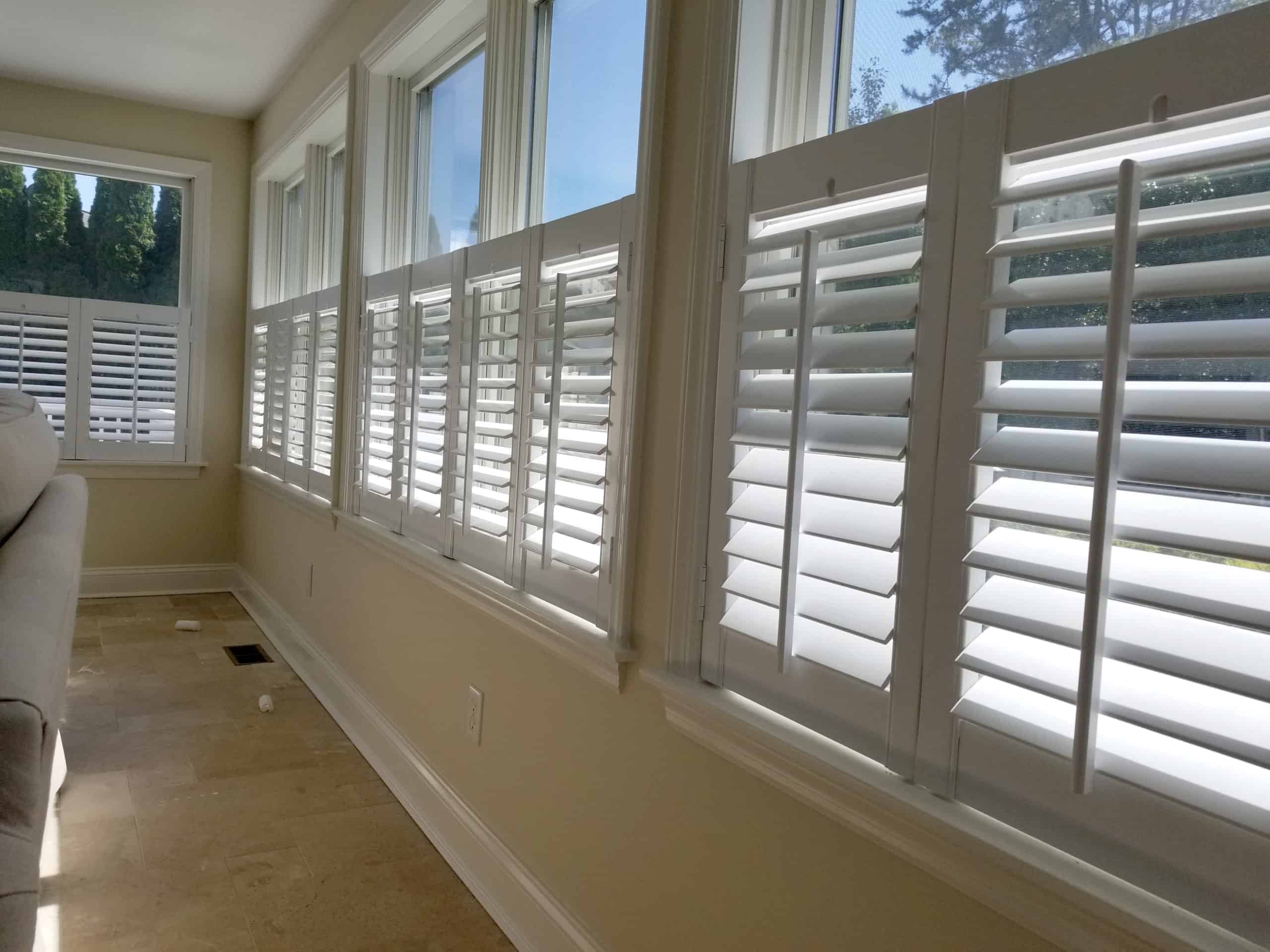
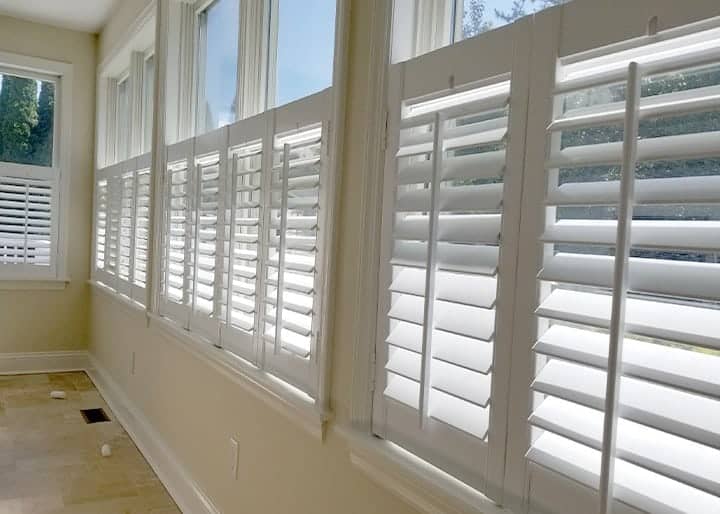
It’s also worth thinking about the frame material, not just the hardware. Polysatin and composite shutter frames are non-porous, which means salt residue doesn’t penetrate the surface the way it can with painted wood or MDF. A quick wipe-down removes what accumulates on the surface. That’s the kind of low-maintenance durability that makes sense for a beach house, a vacation rental in Calabash, or a retirement home in Carolina Shores where you want things to just work without constant upkeep.
The bottom line: when you’re choosing window treatments for any home within reach of the coast — and in Brunswick County, that’s most of them — corrosion-resistant hardware isn’t a premium upgrade. It’s the minimum standard worth accepting.
Coastal Home Window Coverings: UV Protection and Fade Prevention for Ocean-Facing Rooms
Coastal sun is different. It’s not just that there’s more of it — though there is — it’s that water reflects it. If your home faces the ocean or sits along one of Brunswick County’s tidal waterways, your south- and east-facing windows are taking in direct sunlight plus reflected UV from the water’s surface. That combination is hard on everything: hardwood floors, upholstery, area rugs, artwork, and any fabric treatment that isn’t specifically rated for UV exposure.
Solar shades are one of the most practical solutions for ocean-facing or high-sun rooms. A quality solar shade can block up to 99% of UV rays while still preserving your view, depending on the openness factor you choose. A 3% openness fabric significantly reduces glare and UV while keeping the water visible. A 10% or 14% openness fabric lets in more light and view but still provides meaningful UV protection compared to an uncovered window. The right choice depends on the room’s orientation, how much direct sun it receives, and how much privacy matters at different times of day.
Beyond solar shades, UV-resistant fabrics and finishes matter for any treatment in a sun-heavy room. We work with Hunter Douglas, which offers GREENGUARD Gold certified products with UV-resistant coatings that are independently tested — not just labeled. That kind of third-party verification matters when you’re making a purchase that’s supposed to last 10 to 15 years in a coastal environment.
One thing worth knowing: UV damage to your floors and furniture starts immediately. Every season without appropriate window coverage is a season of fading and degradation that can’t be reversed. New-construction homeowners in communities like Brunswick Forest or Ocean Ridge Plantation sometimes wait a full year before addressing window treatments — by which point the hardwood floors in their sun-drenched great rooms have already started to show it. Getting the right treatments in place early isn’t just about comfort. It’s about protecting what you’ve already invested in the home itself.
Coastal Window Treatment Maintenance: What the Schedule Actually Looks Like
Even the best coastal-grade materials need some attention. The good news is that faux wood, PVC, and polysatin treatments are about as low-maintenance as window coverings get — which is exactly why they make sense for the coast. But “low-maintenance” doesn’t mean “no maintenance,” especially in an environment where salt and humidity are constant factors.
A simple routine keeps coastal window treatments performing well for years. Weekly, a light wipe with a damp cloth removes salt dust and fine particulate that accumulates on surfaces near the water. Monthly, a slightly more thorough wipe-down with mild soap and water handles any buildup on slats, frames, and hardware. Once a year, it’s worth checking the hardware — hinges, tilt mechanisms, mounting brackets — for any early signs of wear or corrosion, even on corrosion-resistant components.
That’s genuinely it for most faux wood and PVC treatments. No special products, no professional cleaning required. The simplicity is part of why these materials make so much sense for vacation rental properties in Ocean Isle Beach or Holden Beach, where treatments need to survive heavy use and be easy to clean between guest stays.
How Often Should You Clean Window Treatments in a Brunswick County Home?
The honest answer depends on how close you are to the water and how your home is oriented. A home sitting directly on the oceanfront in Sunset Beach accumulates salt residue significantly faster than a home two miles inland in Shallotte. Wind direction matters too — homes on the south and southwest faces of barrier islands take in more salt air than those with natural wind breaks.
That said, a weekly light wipe is a reasonable baseline for any coastal home in Brunswick County, even if you’re not right on the beach. The Intracoastal Waterway runs through much of the county, and homes along it — even those that feel distinctly inland — still experience elevated humidity and periodic salt exposure. It’s easy to underestimate how far salt air travels on a windy day.
For vacation rental properties, the cleaning schedule should be tied to guest turnover, not just a calendar. Between every rental stay, window treatments should be wiped down as part of the standard turnover process. This isn’t just about aesthetics — it’s about catching any hardware issues early, before a guest notices a stiff tilt rod or a bracket that’s starting to loosen. Rental properties in places like Ocean Isle Beach see 30 to 40 occupied weeks per year in a strong season. That’s a lot of wear, and treatments that aren’t maintained between stays show it quickly.
Fabric treatments — draperies, woven wood shades, Roman shades — require more attention in coastal environments. Humidity can promote mildew growth in fabric that stays damp, and salt residue is harder to remove from textured surfaces than from smooth faux wood or vinyl. If fabric is part of the design plan, choosing moisture-resistant or treated fabrics, keeping windows closed during high-wind salt events, and vacuuming treatments regularly all help extend their life. For most coastal rooms, the simpler the material, the easier the maintenance — and the longer it lasts.
Storm Season in Brunswick County: What Window Treatments Need to Handle
Hurricane season runs June through November, and if you’ve been in Brunswick County through Florence or Dorian, you don’t need to be convinced that storm preparedness is real. What you might not have thought about is how your window treatments factor into that picture.
Decorative interior window treatments — blinds, shades, shutters — are not storm protection. They’re not designed to withstand hurricane-force wind pressure, and they shouldn’t be treated as a substitute for impact-rated windows or hurricane shutters. Before a significant storm, interior treatments should be raised or secured so they’re not damaged by wind pressure if a window fails. That’s a simple step most people don’t think about until after something goes wrong.
Where window treatments do play a role in storm readiness is in the hardware and mounting. Treatments that are professionally measured and installed with proper mounting depth and secure brackets are far less likely to pull away from the wall during pressure changes or minor wind events. Treatments that were measured improperly or mounted with inadequate hardware are more likely to fail — not just in storms, but under the general stress of a coastal environment. Professional installation isn’t just about appearance. It’s about the treatment staying where it’s supposed to be.
We also install hurricane shutters, which is a capability most window treatment companies in the area don’t offer. For homeowners who want a single point of contact for both their everyday window treatments and their storm protection — rather than coordinating two separate contractors — that matters. It’s one less thing to manage in a market where hurricane season is a real annual consideration, not a theoretical one. Whether you’re setting up a primary residence in Leland or a vacation rental on Holden Beach, getting both pieces handled together just makes the process simpler.
Finding the Right Coastal Window Treatment Installer in Brunswick County, NC
Choosing window treatments for a coastal home is genuinely different from any other buying decision in this category. The materials matter more. The hardware matters more. The installation matters more. And the person doing the work needs to actually understand the environment — not just sell you something that looks good in a showroom.
Brunswick County has a lot of options, but not all of them are built around the specific conditions you’re dealing with on the coast. If you’re in a new-construction home in Compass Pointe, a vacation rental on Ocean Isle Beach, or a retirement home in Carolina Shores, the right treatment for your windows isn’t a generic answer. It depends on your orientation, your proximity to the water, how the home is used, and what you actually need it to do.
We bring samples directly to your home — no showroom required — and handle everything from measurement to installation. If you’re ready to stop guessing and get it done right, reach out and schedule your free in-home consultation.