Summary:
If you’ve been staring at a browser tab full of shade options trying to figure out what you actually need, you’re not alone. Blackout roller shades, solar shades, room darkening, light filtering — the terminology alone is enough to make you close the laptop and do nothing.
Here’s the thing: the right answer depends on the room, the window, and how you live in your home. And in Brunswick County, there are a few coastal-specific factors that change the equation in ways most generic buying guides never mention. This page cuts through the noise so you can make a confident decision — or at least know the right questions to ask.
Blackout Roller Shades vs Solar Shades: What's the Actual Difference?
At their core, these two products solve different problems. Blackout roller shades are designed to eliminate light — full stop. The fabric itself allows zero light transmission, so when the shade is down, the room goes dark. Solar shades, on the other hand, are designed to filter light, not block it. They reduce glare, cut UV rays, and take the edge off solar heat gain, all while keeping your view of the water or the yard intact.
Neither one is universally better. A solar shade in a bedroom won’t help you sleep past 6 a.m. in July. A blackout shade in your living room means pulling it down every time you want to watch TV and losing your view entirely. The real question is what each room actually needs — and that’s where most people get stuck.
What Room Darkening Shades Actually Mean (And Why It Matters)

This is where a lot of buyers get tripped up. “Room darkening” and “blackout” are often used interchangeably in product listings, but they’re not the same thing — and the difference is noticeable, especially in a beach community where the sun rises early, sits high, and reflects off the water.
Room darkening shades typically block somewhere between 95% and 99% of light through the fabric itself. That sounds impressive, and it is — but it still means light bleeds through around the edges, and depending on the fabric, you may see a faint glow through the material in direct sun. For a living room or a home office, that’s usually fine. For a master bedroom in Oak Island where the sun comes up over the Atlantic at 6:15 in the summer, it’s the difference between sleeping in and lying there frustrated.
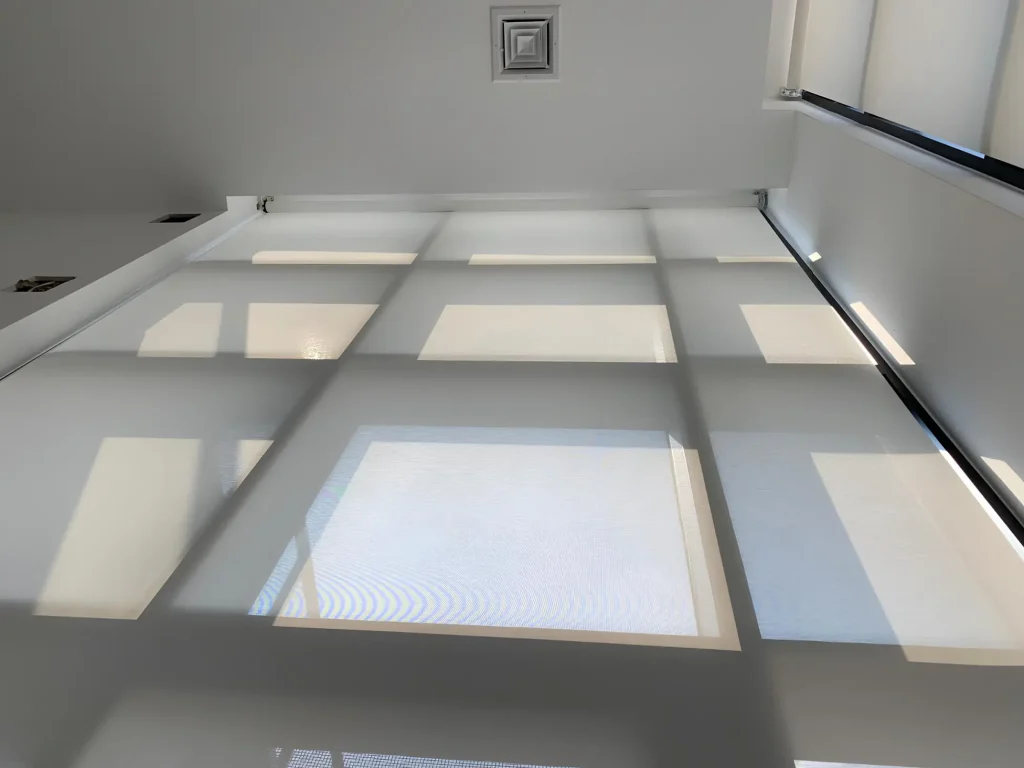
True blackout shades use a fabric construction — often a coated or multi-layered weave — that allows zero light through the material itself. Combined with proper installation, they create genuine darkness. That’s why the fabric choice matters, but the installation matters just as much. A blackout fabric installed with gaps at the sides or top still lets light pour in around the edges, which defeats the whole purpose.
This is one of the most common disappointments we see from people who bought shades online and installed them themselves. The fabric was technically blackout-rated, but the mount type was wrong, or the shade was cut slightly narrow, and the room never got truly dark. Getting the measurement and mount type right — inside mount versus outside mount, with or without a cassette valance — is what separates a shade that works from one that almost works.
Solar Shades and the One Thing Most People Don't Know About Nighttime Privacy
Solar shades work on a simple principle: during the day, the light outside is brighter than the light inside, so you can see out but people can’t see in. It’s a one-way effect that makes them feel almost magical in the right setting — you get your view, your UV protection, and a significant reduction in glare without the room feeling closed off.
But at night, that equation flips. When your interior lights are on and it’s dark outside, anyone walking past can see directly into your home through a solar shade. This surprises a lot of people, especially those who assumed the shade would work the same way around the clock. It doesn’t.
For Brunswick County homeowners on the water, in neighborhoods with close lot lines, or in vacation rentals where guests come from all over and may not think to close their shades at night — this matters. The standard professional recommendation is to layer solar shades with blackout roller shades or drapery for rooms where you need both daytime UV control and nighttime privacy. It sounds like extra cost, but it’s actually the most functional setup for living rooms, sunrooms, and primary bedrooms in coastal homes.
Solar shades also come in different openness factors — typically ranging from 1% to 14%. A 1% openness gives you maximum UV blockage with very little view-through; a 5% to 10% openness balances visibility with glare reduction. For a home facing the Intracoastal Waterway or a west-facing room that takes a beating in the afternoon, a tighter openness factor makes a real difference in how much heat gets through. Solar shades can reduce solar heat gain by roughly 30%, which adds up on a July afternoon in Shallotte or Leland when your air conditioning is already working overtime.
Blackout Shades for Brunswick County Homes: What the Coastal Environment Changes
Most window treatment content is written for generic markets — suburban homes in moderate climates with standard windows and predictable sun exposure. Brunswick County is none of those things. The UV intensity here is higher than most inland markets, the salt air accelerates material degradation, humidity is a year-round factor, and a significant portion of homes are vacation rentals that see heavy use from guests who don’t treat the shades gently.
That changes what you should be buying and what you should be asking for. Not every fabric holds up in a coastal environment. Not every hardware finish resists rust. And not every installer has worked in homes where the windows face open water and get direct sun for six or eight hours a day.

Why Vacation Rental Owners in Oak Island and Holden Beach Need to Think Differently
If you own a rental property on Oak Island, Holden Beach, Ocean Isle Beach, or Sunset Beach, your window treatment decision isn’t just about aesthetics. It’s a guest experience decision, a durability decision, and frankly, a ratings decision.
Guests in beach rentals keep irregular hours. They stay up late, sleep in, and often come from time zones that don’t match the local sunrise. A bedroom that doesn’t get genuinely dark is a bedroom that gets mentioned in reviews — and not in a good way. Properly installed blackout roller shades in every sleeping room are one of the highest-impact, lowest-cost upgrades a rental property owner can make. It’s the kind of detail that turns a three-star sleep experience into a five-star one.
Durability matters just as much. Vacation rental shades take a beating. Guests pull them down hard, leave them down in direct sun for days at a time, and occasionally treat them like they’re indestructible. Materials that aren’t rated for coastal UV exposure and repeated use will fade, warp, or fail within a season or two. We specifically work with fabrics and hardware designed for this environment — moisture-resistant, UV-stabilized, and built to handle the kind of use that a short-term rental sees across a full season.
There’s also the practical reality of turnover. Shades that are easy to operate, hold their position reliably, and look clean in listing photos aren’t a luxury — they’re a baseline expectation for guests browsing VRBO or Airbnb. A motorized option is worth serious consideration for rental properties where ease of use and a polished appearance both matter.
How Blackout Shades and Hurricane Shutters Work Together for Year-Round Protection
This is something almost no window treatment company in the area can speak to, because almost none of them install hurricane shutters. We do — and it changes the conversation for Brunswick County homeowners who are thinking about their windows as a whole system, not just a decorating decision.
Hurricane Florence hit Brunswick County hard in 2018. Dorian came through in 2019. Isaias in 2020. If you’ve lived here through any of those seasons, you know that window protection isn’t abstract. It’s something you think about when the forecast changes and you’re trying to decide whether to stay or go.
Hurricane shutters handle the structural protection side — keeping wind, debris, and rain from compromising your windows during a storm. Blackout roller shades handle the everyday side — light control, energy efficiency, privacy, and UV protection during the 364 days a year when there’s no storm in the forecast. They serve completely different functions, but they work together as a complete approach to window protection for coastal homes.
For homeowners in Southport, Calabash, or anywhere along the Brunswick County coastline who want to address both, we’re one of the few providers in the area who can handle the full scope in a single conversation. That’s not a small thing when you’re trying to coordinate multiple contractors and vendors around a project. We bring samples, measure the same visit, give you firm pricing on the spot, and handle installation ourselves — no subcontractors, no handoffs.
For new homeowners in Leland’s growing neighborhoods or retirees settling into communities like Brunswick Forest or Compass Pointe, that kind of straightforward, all-in-one service tends to be exactly what makes the process feel manageable rather than overwhelming.
Ready to Choose the Right Shades for Your Brunswick County Home?
The short version: solar shades are the right call for rooms where you want UV protection, glare reduction, and a preserved view — think living rooms, sunrooms, and any space that faces the water. Blackout roller shades belong in bedrooms, nurseries, and any room where genuine darkness actually matters. Room darkening shades sit in the middle and work well where you want significant light reduction without the full commitment. And in many coastal homes, layering both solar and blackout shades in the same room is the most functional approach of all.
What makes the biggest difference isn’t just which product you choose — it’s whether it’s measured correctly, mounted the right way, and made from materials that hold up in this environment. That’s where a lot of DIY and big-box purchases fall short.
If you’re ready to stop guessing and actually see how these options look in your home, we bring samples directly to you, measure on the same visit, and give you straightforward pricing before you commit to anything. Reach out and let’s figure out what your windows actually need.